Showing posts with label RPGs. Show all posts

Friday, January 6, 2012

Double Barreled


 As a result of the holiday tradition of gift giving I now have access to a working scanner. I also managed to dig up a pile of old game notes that I thought I'd lost, including what looks like a complete dungeon. Time will tell whether or not I scan all of it, but some of it will show up here. Here's a sample of what I have. During a sf campaign one player wanted both a laser rifle and a slug thrower, but wanted to avoid the encumbrance penalties for carrying around two weapons. So he wanted a combined laser/slug thrower rifle. The sketch on the right is his concept of what the weapon would look like. The two to the left are "transitional forms" you might say, of a bulky laser rifle and a provisional design. On the bottom is the final rifle design I came up with for him.

And you'll notice that in the right-hand margin someone has written "John W. Campbell, Anthology Trilogy." That's not my handwriting so it's just as much a mystery to me as it is to you. Presumably it refers to his Astounding Science Fiction anthologies, which shows that we were at least drawing on some good source material.

Thursday, December 22, 2011

Indistinguishable from magic

Adam, Zak S. and Jeff R. have all been musing about magic lately. Sounds fun, so I'll chime in. Probably as a result of playing T&T, I tend to regard magic as a specialized form of psi power. (As you can imagine, I've never been a fan of the way D&D adds a separate (and IMO clunky) system for psionics.) This is more in keeping with Vance's idea of magic, too. I tend to imagine it being more like Norton's Witch World or Bradley's Darkover series, where magic ain't nothin' but psi misspelled.

(3rd edition hardback)

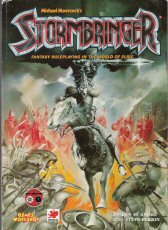
For a straight-up magic system my favorite is still the one from Ken St. Andre & Steve Perrin's Stormbringer. The system revolves around summoning and binding elementals and/or demons. In case you're wondering, the psi angle is that your mind is reaching out to another plane of existence and drawing those creatures to you. The cool thing about the system is that it's simple but very versatile. You do all the usual stupid wizard tricks, like cast a fireball (fire elemental) or make a flying carpet (demon of travel). And it naturally limits magic powers, since demons of combat can be very dangerous. If you pick up a magic sword in this game it could kill you.


In more general terms, I don't see why magic couldn't be done with straight psi powers. You could even use them to explain most superpowers. Super strength is just psychokinesis with no range, fireballs are just a special form of pyrokinesis, x-ray vision is a type of clairvoyance, etc. One thing that really got me thinking this way was Claude J. Pelletier's excellent article "Put Some Magic In It" which used the Mekton II psionic rules as a framework for a magic system. But why bother with separate rules? Why not just use the psionic rules to account for "spells"? There are a few things that standard psionic rules don't cover, like shapeshifting or breathing water, but it's easy to expand the rules to cover that stuff.

And really it just comes down to a matter of semantics.As Jeff R. showed, whether you want your Magic Missile to be a bolt of mind force or a spray of pixie dust is all up to you.

Friday, December 16, 2011

"That's no moon..."

Marc Miller's Traveller (1977) introduced a system for randomly generating space maps that has been widely imitated. One thing that is sometimes overlooked in these systems is the possibility of exotic interstellar phenomena. That's what makes David Cook's planet generation system for TSR's Star Frontiers (1982) so interesting. It appeared in Ares Magazine Special Edition #2 (1983) and when rolling up a system there was a 1% chance you'd roll on a "Special Feature Table" that covered unusual deep space objects.

Special Feature Table

Die Roll...Feature
01-03.....Alien artifact
04..........Alien lifeform
05-06....Artificial world
07.........Black hole
08-20...Dead star
21-22...Derelict spaceship
23-50...Dust cloud
51........Neutron star
52-71...Protostar
72-80...Rogue planet
81-99...Supernova remnant
00........White hole

Most of those features should be self-explanatory. Dust clouds cover 1D10 cubic light-years and may interfere with communications, as might neutron stars, supernova remnants, et al. Artificial worlds can be anything from a hollow asteroid to a ringworld or Dyson sphere. You get the idea. So the nest time you're rolling up a space map throw in a few special features to spice things up.

Thursday, December 8, 2011

The History of FASA Trek

You probably already know the story of Guy W. McLimore, Greg Poehlein & David F. Tepool's Mekton supplement, Mekton Empire (1990). But there's an equally interesting tale behind their development of FASA's Star Trek RPG. A couple things really stand out to me. One is that they had to do a rush job on the project. That probably explains why the campaign advice was so sparse. Another is that they eventually split with FASA over the company's push to militarize the game. But I'll let McLimore tell the story in his own words.

1st edition cover

Star Trek: the Roleplaying Game

Guy McLimore, Greg Poehlein, and Dave Tepool were privileged to add their small part to the Star Trek legend as the authors of Star Trek: The Role Playing Game for FASA Corporation. As long time Trekfans, the trio is still very proud of the work they did on this project in its early days.

Guy, Greg, and Dave, operating at that time as Fantasimulations Associates, were assigned the Star Trek project by FASA after five other design teams had failed to turn in a manuscript that both FASA and Paramount Pictures would approve. FASA's license option was about to run out, and they needed to get a product into print almost immediately.

"We had only a few weeks to create character creation, character combat, and starship combat systems," remembers Guy. "When we made that deadline, FASA assigned us the entire project." It was to absorb almost all of their design efforts for the next several years. Guy, Greg, and Dave created the first edition of the basic ST:RPG rules, which debuted at a Trek convention in Omaha, Nebraska. The game was an immediate success, and soon became the second best selling RPG in history at the time (although well behind #1 - Advanced Dungeons and Dragons).

The first boxed set included both the role playing rules and a role playing style starship combat system that remains unique among game systems. Instead of a tactical board game, the role playing combat system offered players the chance to sit at "consoles" for the various bridge stations and perform their duties by allocating power to various systems, setting course, activating the shields, and firing weapons.

A series of expansion volumes soon followed, all written by Guy, Greg, and Dave, including The Klingons, The Romulans, and Trader Captains and Merchant Princes, which introduced non-military personnel as player characters for the first time. Most of the early adventure supplements were also written by one or more members of the trio. David created and later revised the Star Trek Tactical Ship Combat Simulator, which was eventually boxed as a separate component of the system and probably outsold even the role playing game because of its fast play mechanic and authenticity.

The main books of the system, including the Basic Game and the Klingons, Romulans, and Trader Captains supplements, entered a second edition, using the Fantasimulations Associates systems and text that was edited by John Wheeler. The second editions proved even more popular than the first.

FASA was already pursuing another success story in the form of Battletech. Future warfare was very popular, and FASA was in the forefront of the new gaming craze.

FASA's desire to stress the combat aspects of Star Trek led to disputes between them and the Fantasimulations Associates designers, who wanted to maintain the less-violent focus of the Star Trek TV series. This led to ST:RPG projects being assigned to other designers, and eventually to a payment dispute which ended the three Fantasimulations Associates designers' association with FASA and the Star Trek property.

The later ST:RPG works became very controversial in fandom because of their focus on military themes. Gene Roddenberry returned to active interest in licensing (during the initial planning of Star Trek: The Next Generation) and was reportedly unhappy with the change of approach to the game materials. A number of proposed FASA projects were turned down when submitted to Paramount for approval. One short-lived sourcebook was actually sent to press and distributed before Paramount had ruled on it. When it was turned down by the licensee, Paramount insisted that FASA withdraw the book from publication.

Eventually FASA's license to produce Star Trek materials was not renewed, and the game went out of print. Copies usually bring high prices from used game dealers. Paramount never again allowed a role playing game license to be sold for any Star Trek property, despite the interest of companies such as TSR, Mayfair Games, and Steve Jackson Games, until January 1998, when a license was granted to Last Unicorn Games.

Wednesday, November 30, 2011

Klingon Random Name Generator

I was looking through my RPG stuff to find some of my old notes, but it doesn't seem like much has survived. I think most of it got thrown out one of the times I moved. Bummer. One thing I did find is something I don't even remember doing. It's a Klingon Random Name generator for...I don't know what. I guess I must have wanted names for Klingon NPCs in a Star Trek game, but I can't for the life of me remember the details. Nevertheless, here it is in all its mysterious glory.

Klingon Random Name Generator

I: Given Name:

First Letter (Roll one die): 1-3 = K-, 4-5 = Q-, 6 = M-

Mid. Syllable (Roll one die): 1 = -ar-, 2 = -il-, 3 = -ah-, 4 = -ir-, 5 = -al-, 6 = (Roll on Short-Name chart)

Last Syll. (Roll two dice): 2 = -dar, 3 = -gran, 4 = -mtav, 5 = -rvan, 6 = -gga, 7 = -mato, 8 = -tarc, 9 = -gak, 10 = -gar, 11 = -ssa, 12 = -ramark

Short-Name Chart (Roll one die): 1 = -or, 2 = -ruge, 3 = -ang, 4 = -ex, 5 = -zak, 6 = -altz

II: Honorific (one die): 1 = no honorific, 2 = tai-, 3 = vestai-, 4 = sutai-, 5 = zantai-, 6 = epetai-

(NOTE: The honorific is added as a prefix to the line-name.)

III: Line-name:

First Syll. (Roll two dice): 2 = Sol-, 3 = Jur-, 4 = Sub-, 5 = Hav-, 6 = Pal-, 7 = Ney-, 8 = Tre-, 9 = Jav-, 10 = Hur-, 11 = Lim-, 12 = Uru-

Mid. Syll. (Roll one die): 1 = -ai-, 2 = -ge-, 3 = -us-, 4 = -az-, 5 = -la-, 6 = (No middle syllable)

Last syllable (Roll two dice): 2 = -esh, 3 = -ra, 4 = -iss, 5 = -bh, 6 = -arn, 7 = -th, 8 = -ric, 9 = -sig, 10 = -exa, 11 = -vrk, 12 = -ltz


That's it. Let's see how well it works...

#1: Qang vestai-Palgeth
#2:  Qilgga sutai-Neyaziss
#3:  Kirmato vestai-Neygeric

Qapla'! Not half bad, although the slight bell-curve on those 2D rolls weights things toward the middle. Good enough for a quick-and-dirty Klingon NPC or two though. But what do I know? tlhIngan Hol vIjatlhbe'!

Wednesday, November 23, 2011

FASA Trek's prescience

Guy McLimore, Greg Poehlein, and David Tepool's Star Trek: The Role Playing Game (1982) had a lot of interesting points. While generally staying true to the Star Trek universe, it also emphasized some aspects that were more reminisent of Marc Miller's Traveller (1977). For example, the supplement Trader Captains and Merchant Princes (1983), which let players unleash their inner Harry Mudd. But in the equipment lists of that book was something remarkable, even uncanny. It came disguised as a simple description of a data storage card, or "computer cart."

The text seems to be describing a standard memory tape, but look at the illustration. Look familiar? That's no memory tape, it's a USB flash drive.


But flash drives weren't around until c. 2000 CE, eighteen years after that game was published. This is highly illogical. Is it a clue planted by a time traveler, as in Asimov's The End of Eternity? Did the game designers have precognitive abilities? What's going on here?


Thursday, November 17, 2011

Glitches

The R. Talsorian sourcebook for Cyberpunk based on Walter Jon Williams' book Hardwired (1986) included some interesting variations on the core rules. Most significantly, the netrunning rules were revamped to a more realistic system. CP2020 is a good game, but the treatment of cyberspace is very idiosyncratic, to say the least. Another thing I like is the table of "glitches" for NPCs. These are personality quirks that can give characters a distinctive personality. It's like a quick-and-dirty Life Path. To determine the number of glitches, roll 1D10. 1-5 = 1 glitch, 6-8 = 2 glitches, 9-10 = 3 glitches. Roll 2D10 for each glitch and cross-index on the Glitch Table.


Friday, November 11, 2011

Radiation rules

I was browsing Joseph Heck's Traveller website and found these rules for radiation poisoning from GDW's Twilight 2000. They are very realistic (i.e., lethal) and will work as written with any game that has a stat range of 1-10. In games that don't have a Constitution stat just use the equivalent; e.g, in Interlock use the Body Type stat, in CORPS or Action! System use Health, etc.

Date: Fri, 29 Sep 1995 12:30:17 -0700 (PDT)
From: John ---- ---------- <-------@uclink.berkeley.edu>
Subject: Rads
Re: Radiation T:2000 rules

Effects of Exposure: Exposure to lower levels of radiation will produce temporary illness, while higher levels can kill. All exposure is cumulative. When a character's accumulated rads reach or surpass 50, he must be checked for radiation illness. Thereafter, each time the character accumulates one or more rads he must be checked for radation illness. however, the character is checked for radiation illness only once per day on each day that he accumulates additional rads.

The Radiation Illness Chart (below) gives the multipliers used to determine the chances of illness and death from exposure to radiation. Use the rad level on the chart that is closest to (without exceeding) his accumulated rad level.

Rads...Slight Illness...Serious Illness...Death
50.............1.0..............nil....................nil
100............0.5............1.0...................nil
300............0.2............0.5..................1.0
400...........Auto..........0.2...................0.5
600...........Auto..........Auto................0.2
800...........Auto..........Auto................Auto

Multiply the character's Constitution by the multiplier to determine his target number (round fractions up). Roll 1D10. If the number rolled is equal to or less than the chance, the character avoids the effect.

Slight Illness: Nausea, vomiting, and headaches. Onset is 1D6 hours after exposure. The character has strength, agility, and intelligence halved for the duration of the illness. Symptoms last one day at lower levels, two days if exposure is greater than 600 rads.

Serious Illness: First suffers slight illness, as above,. Then suffers serious illness and is incapacitated with severe vomiting and diarrhea, spotting on the body caused by bleeding under teh skin, and blood int he stool and vomit. Onset of serious illness is 2D6 days after exposere at levels less than 300 rads, 1D6 at levels above that. Incapacitation lasts 1D6 days, plus one day for every two days spent without bed rest and medical care. The amount of medical care required is the same as for a character with a serious wound to two body parts -- or two additional body parts if the character is already wounded. General illness, approximating the effects of slight illness listed above, will persist for 1D6 weeks.

Death: The character first suffers from slight radiation illness and then from serious radiation illness. During the incapacitation period (and usually within 30 days of exposure) the character dies.

At higher tech levles, presumably an automed could treat slight and serious illness at increasing levels of exposure, and a full medical facility could prevent death, and "roll-back" a persons cumulative exposure. The description in FF&S of the consequences of getting too close to a Fusion Drive suggest that bone marrow transplants etc, would be necessary, so presumably the character is till going to be laid up for some time.

*Apologies to those not interested in radiation, but enough people had expressed an interest that I thought it was worthwhile.
--M


Whether or not you want to use these rules depends on how realistic you want to be. They would be very useful in a hard sf game but would be inappropriate in a planetary romance or superhero game. If you do use them in a super-science game - a space opera setting like Star Trek, for example - you might want to allow medical science to provide a cure, like the original poster suggested. Assuming the doctor has the necessary drugs on hand and makes a successful skill roll she could alleviate the effects of the radiation poisoning. If the science is sufficiently advanced you could even allow treatment that would reduce the number of rads the character has accumulated.

Thursday, November 3, 2011

Warp "speed"


I know Warp 6 is slow, but as Murphy's Rules points out Warp 7 isn't much better.

Tuesday, September 20, 2011

Chariot of the Gods

RuneQuest is a game that will always be associated with the fictional world of Glorantha. This is despite the fact that the game's authors have always encouraged players to use it for other settings. In the introduction to the 2nd edition of 1979 they emphasize the novelty at that time of situating a game in a particular world, but also recommend that it be used in other venues.

However, this game is not limited to Glorantha. The experience system, the combat system, most of the magic system, and the training/guild system, and everything but the specific references to the world of Glorantha can be adjusted to fit any time and space with a minimum of hassle. We think you will find this system more realistic, and at the same time more playable, than any system you have seen before.

They even published Questworld, a non-Glorantha setting for the game. It never caught on. When the third edition was released by Avalon Hill some years later they went a step further. The default setting of the game was changed to a fantasy version of Europe, with Glorantha provided as an optional setting. They even included a nice map in the rules.


This is a great map. It has the feel of a pre-modern map. It's a little crude, a little sketchy, but has enough details to be useful for the players. I like this much better than the overly realistic maps in some games. (As much as I admire the world building that went into HârnWorld, the presentation in the form of a modern atlas always struck me as somewhat anachronistic for a pseudo-medieval fantasy setting.) One curious thing about the map is that mountain in east of "Libya" labeled "Chariot of Gods." Just what is that? For me it brings to mind all those stories of ancient astronauts, aliens from other worlds mistaken for gods by earthlings. It's easy to envision a group of PCs mounting a major expedition to explore it, with plenty of adventures on the way and an encounter with strange creatures from the void at the end. Despite intriguing features like this, and further supplements like Eldarad, these non-Glorantha settings never caught on. For most gamers RuneQuest remained synonymous with Glorantha. And so the Chariot of the Gods remains a mystery waiting to be explored.

Friday, September 2, 2011

Hercules vs. Bat Demon

I think we've all had encounters like this. I wonder if Hercules will have to get a rabies shot now?

Saturday, August 27, 2011

Ugly Americans RPG?

I really dig the show Ugly Americans. It's is set in an alternative New York city peopled by monsters, wizards, mutants and demons. It's like the typical FRPG populace in an urban setting. Here's a taste.

Ugly AmericansThursdays 10:30/9:30c
Battle of the Summer Solstice
www.comedycentral.com
New Episodes Oct 6, 10:30pm/9:30cDepartment of Integration Field GuideFollow the Show on Twitter

As I see it, the PC's would all live in the same big city, and all share the same menial job, like taxi driver, security guards or working at a Rat On A Stick franchise. As for the rules set, the obvious choice would be Toon. There's already a fan made Futurama game using Toon floating around out there, so having an Ugly Americans one too is only natural. But another good choice would be Goblinoid Games' Labyrinth Lord and Mutant Future. LL has all the monsters, wizards and zombies you need for the game, while MF has the stats for the robots, mutants, etc. A few minor tweaks and your ready for downtown weirdness. With the right players I think it would make for a great, off-beat campaign.

Thursday, July 21, 2011

Superhero Costume Generator

This should account for about 80% of all superhero costumes.

Roll 1D6.

1-3 = Unitard*
4-5 = Zentai suit**
6= Leotard

* Roll 1D6: 1-3, w/Cape; 4-6, w/o Cape

** Roll 1D6: 1-3, Covers upper face; 4-5, Open Faced; 6, Covers Head

Saturday, July 2, 2011

Spaghetti Bronze Age

I suppose I  didn't make it very clear in my post yesterday that when I talk about a fantasy game set in the Bronze Age, I'm not so much thinking of the actual historical period as those cheesy old sword-and-sandal films.


A lot of them were made on shoestring budgets, so you'd want to add more magic and monsters than most of them feature, but in general that's what I had in mind.


Whether or not you want to have Hercules running around as a major NPC is up to you, but it could make for an interesting encounter.

Monday, June 13, 2011

Punknaught!


This is a weird case of life imitating art. Remember the Punknaught from Chromebook 1? It turns out the Mexican narco cartels are building their own version of the things. At least they don't hover -- yet.


Every riot cop's nightmare!

Wednesday, May 18, 2011

BRP & Me

Adam has an interesting post linking to another post arguing that RQ/BRP is better than D&D. I agree in so far as I personally like the BRP system better than D&D's mechanics, but I wouldn't claim one is better than the other. It's like arguing about whether DC is better than Marvel or vice versa. It's really just a matter of taste. But I do prefer BRP. In fact, it's one of my favorite game systems. If you've read this blog before that may come as something of a surprise since aside from the occasional mention of Call of Cthulhu or Elric!/Stormbringer I hardly ever talk about it. That's because I don't play it any more. How can it be one of my favorite systems if I don't play it? I'll explain that later. First, let me spell out why I like it.


One of my favorite things about BRP is the ease of play. You roll your attributes, then pick a few skills to define your character and you're off. What I like even more is that it completely does away with character classes and experience points. Character classes are nothing but a group of skills, either implied or enumerated. With a skill system classes become superfluous. Want to be a thief? Give your character the skills Pick Pockets, Move Quietly, Spot Trap, etc. Want to be a fighter? Pick a bunch of combat skills. Want to be a fighter and a thief? You don't have to mess around with some awkward "multi-class" with a separate experience point table, you just choose the mix of skills that fits that kind of character. In fact, you don't have to mess around with experience point charts at all because there are no experience points. If you're like me and you think keeping track of experience points is about as fun as balancing a check book this will make you happy.


The other great thing about this approach is that you can modify the skill list to suit your fancy. Do you have a fighter who wants to use nunchaku? Just add a nunchaku skill. Does someone want a Fast Draw ability? Just add a skill for it. Do you want magic users to be able to smell magic? You got it, Smell Magic skill. This is a great approach to gaming and it's stood the test of time. The BRP system is so stable it has remained virtually unchanged since it first appeared. So why don't I play it any more?

I used to use BRP for just about every game I ran. It was great because the percentile based system was so intuitive that players would pick it up in a snap. The hardest math was multiplying your base attributes by 3 or 5 to get different saving throw values. But the thing about the percentile system is that the skills are defined too finely. If one character has a Boogie skill of 63%  and another has a Boogie skill of 64% that's not a meaningful difference. In fact, to make a real difference you need a much coarser separation on the order of 5-10% or so. So instead of multiplying your attributes by 5 you should be dividing your skills by that much. And once I started thinking along those lines I realized that you didn't need all those different polyhedral dice. Just divide the skills by five and roll that number or less on 3d6. Kind of like GURPS but without the fiddly stuff.

So I moved away from BRP. I still think it's a good system, and it has had an important influence on the hobby, but I doubt I'll be running games with it any time soon.

Friday, May 13, 2011

RPG anarchy

I like the general attitude of Mark C. MacKinnon's BESM/Tri-Stat games which are very much in line with the T&T tradition of modifying the rules to fit your style of play. However, their emphasis on a storytelling style sometimes gets out of hand. For example, in the Tri-Stat rules there's a section on "Moving Beyond Tri-Stat" (pg. 90) which gives advise on doing without rules.

Remember back to your childhood when you played “House,” “Cops and Robbers,” (and perhaps even “Doctor”) with your friends. There were no Character Points, no rules, no dice, and no character sheets at that time. All that mattered was the role-playing. Capturing the essence of those games you played long ago should be your ultimate goal: just role-playing, and nothing else.

There follows sections on how to "Remove the Skills," "Remove the Attribute Levels," "Remove the Dice and Rules," and even "Remove the Game Master." I don't object to any of that in principle, and it could work quite well given the right group of players. I think that's pretty much how those Murder Mystery dinner parties work. The problem is that the role players I'm used to tend to be power gamers and they would not fit well with that approach. MacKinnon recognized that himself sever pages earlier in the section on "Power Abuse" (pg. 86).

The player characters may have tremendous powers. Perhaps they can literally
move mountains, or change the course of history. Sooner or later, someone will
decide to see just how far he or she can go with their character’s powers.

The solution he suggests is GM veto. But if you've done away with the GM then what? If you've thrown out the rules and a player says "I jump to the moon and pick up the alien death ray I find there," who's going to contradict them?

So while I think it's quite possible to have a fun game with no rules and no GM, I think it takes a very particular group of gamers to make it work. The average munchkin is incompatible with that style of play.

But I admit I'm a bit biased. I'm something of a gearhead and I enjoy games like Mekton Z or Hero System where you design your character or mecha for optimal awesomeness. So maybe my fondness for a design system that can be tweaked is skewing my view. Have you ever run a game with no rules or even no GM? How well did it work?

Wednesday, March 30, 2011

Lost, Forgotten

Chaosium's Elric!/Stormbringer 5th had a character generation system that gave players a list of Adventurer Occupations. They could either pick one, or randomly roll on the chart. While most of them were standard fare, like Soldier, Thief, Sailor, etc., one of them was very unusual and evocative.

Lost, Forgotten -- you're a drifter, or a person plagued by dreams and visions, or a young person newly orphaned,  or you just woke up an amnesiac. You don't quite know who you are, and you can't remember a time when you knew. You grasp at strange clues and bewildering notions that never quite work, and scheme for riches that never quite appear. Skills: Conceal Object, Fast Talk, Hide, Insight, Listen, Move Quietly, Search, and one other skill as a personal specialty. Optional Spells: Cloak of Cran Liret (1-4), Midnight (1), Witch Sight (3). Extra Money: 15 bronzes.

My players didn't like the random occupation option, and no one ever chose this one, preferring to stick with more obvious picks. Which is too bad, because this "occupation" is so cool.

Thursday, March 17, 2011

Generating Percentages with 2D6

The Best of the Dragon had a bunch of interesting articles, including one on alternative ways of generating random numbers for games. In "What to Do When the Dog Eats Your Dice," Omar Kwalish listed ideas from the straightforward, like drawing chits, to the bizarre, like plucking chest hairs (WTF?). A couple that I really liked involved ways to generate a wide range of numbers using ordinary six-sided dice.


PERCENTAGES GENERATED WITH TWO STANDARD DICE (D6)

The following table is from FIGHT IN THE SKIES. The column on the left is percentages and numbers needed to get them, while the figures on the right are the actual probabilities. (I.E., if there is a 10% chance of an encounter, a roll of "9" indicates that it occurs. The actual percentage chance of rolling a "9" with two standard dice is 11.1 %.)

05%... 11 5.6%
10% 9 11.1%
15% 6 13.9%
20% 7, 12 19.4%
25% 4, 7 25.0%
30% 7, 8 30.6%
35% 2, 4, 5, 6 36.1%
40% 5, 6, 8 38.9%
45% 6, 7, 8 44.4%
50% 4, 5, 6, 7 50.0%
55% 5, 6, 7, 8 55.6%
60% 3, 5, 6, 7, 8 61.6%
65% 4, 5, 6, 7, 8 63.9
70% 3, 4, 5, 6, 7, 8 69.4%
75% all except 2, 3, 4, 10... 75.0%
80% all except 2, 4, 10 80.6%
85% all except 3, 11, 12 86.1%
90% all except 9 88.9%
95% all except 11 94.4%


USING SIX-SIDERS FOR HIGHER NUMBERS

One six-sided die can be used to determine any number range divisible by two, three or six. (I.E., for 1-100, first roll determines if it is between 1 and 50, or 51-100, the second 1-25 or 26-50 (assuming first roll indicates 1-50), the third determines in which group of five (discarding rolls of "6"), and the last the actual number.)

Sure, you could do it the easy way and generate these numbers using your fancy-schmancy polyhedral dice, but this way's more fun.

Wednesday, February 23, 2011

Astrópía (2007) trailer


This looks awesome, even though it was given the awful title Dorks & Damsels for its US release. Has anyone seen this?