Thursday, December 22, 2011

Indistinguishable from magic

Adam, Zak S. and Jeff R. have all been musing about magic lately. Sounds fun, so I'll chime in. Probably as a result of playing T&T, I tend to regard magic as a specialized form of psi power. (As you can imagine, I've never been a fan of the way D&D adds a separate (and IMO clunky) system for psionics.) This is more in keeping with Vance's idea of magic, too. I tend to imagine it being more like Norton's Witch World or Bradley's Darkover series, where magic ain't nothin' but psi misspelled.

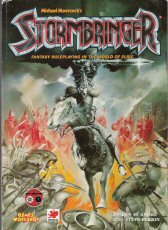
(3rd edition hardback)

For a straight-up magic system my favorite is still the one from Ken St. Andre & Steve Perrin's Stormbringer. The system revolves around summoning and binding elementals and/or demons. In case you're wondering, the psi angle is that your mind is reaching out to another plane of existence and drawing those creatures to you. The cool thing about the system is that it's simple but very versatile. You do all the usual stupid wizard tricks, like cast a fireball (fire elemental) or make a flying carpet (demon of travel). And it naturally limits magic powers, since demons of combat can be very dangerous. If you pick up a magic sword in this game it could kill you.


In more general terms, I don't see why magic couldn't be done with straight psi powers. You could even use them to explain most superpowers. Super strength is just psychokinesis with no range, fireballs are just a special form of pyrokinesis, x-ray vision is a type of clairvoyance, etc. One thing that really got me thinking this way was Claude J. Pelletier's excellent article "Put Some Magic In It" which used the Mekton II psionic rules as a framework for a magic system. But why bother with separate rules? Why not just use the psionic rules to account for "spells"? There are a few things that standard psionic rules don't cover, like shapeshifting or breathing water, but it's easy to expand the rules to cover that stuff.

And really it just comes down to a matter of semantics.As Jeff R. showed, whether you want your Magic Missile to be a bolt of mind force or a spray of pixie dust is all up to you.

Friday, December 16, 2011

"That's no moon..."

Marc Miller's Traveller (1977) introduced a system for randomly generating space maps that has been widely imitated. One thing that is sometimes overlooked in these systems is the possibility of exotic interstellar phenomena. That's what makes David Cook's planet generation system for TSR's Star Frontiers (1982) so interesting. It appeared in Ares Magazine Special Edition #2 (1983) and when rolling up a system there was a 1% chance you'd roll on a "Special Feature Table" that covered unusual deep space objects.

Special Feature Table

Die Roll...Feature
01-03.....Alien artifact
04..........Alien lifeform
05-06....Artificial world
07.........Black hole
08-20...Dead star
21-22...Derelict spaceship
23-50...Dust cloud
51........Neutron star
52-71...Protostar
72-80...Rogue planet
81-99...Supernova remnant
00........White hole

Most of those features should be self-explanatory. Dust clouds cover 1D10 cubic light-years and may interfere with communications, as might neutron stars, supernova remnants, et al. Artificial worlds can be anything from a hollow asteroid to a ringworld or Dyson sphere. You get the idea. So the nest time you're rolling up a space map throw in a few special features to spice things up.

Thursday, December 8, 2011

The History of FASA Trek

You probably already know the story of Guy W. McLimore, Greg Poehlein & David F. Tepool's Mekton supplement, Mekton Empire (1990). But there's an equally interesting tale behind their development of FASA's Star Trek RPG. A couple things really stand out to me. One is that they had to do a rush job on the project. That probably explains why the campaign advice was so sparse. Another is that they eventually split with FASA over the company's push to militarize the game. But I'll let McLimore tell the story in his own words.

1st edition cover

Star Trek: the Roleplaying Game

Guy McLimore, Greg Poehlein, and Dave Tepool were privileged to add their small part to the Star Trek legend as the authors of Star Trek: The Role Playing Game for FASA Corporation. As long time Trekfans, the trio is still very proud of the work they did on this project in its early days.

Guy, Greg, and Dave, operating at that time as Fantasimulations Associates, were assigned the Star Trek project by FASA after five other design teams had failed to turn in a manuscript that both FASA and Paramount Pictures would approve. FASA's license option was about to run out, and they needed to get a product into print almost immediately.

"We had only a few weeks to create character creation, character combat, and starship combat systems," remembers Guy. "When we made that deadline, FASA assigned us the entire project." It was to absorb almost all of their design efforts for the next several years. Guy, Greg, and Dave created the first edition of the basic ST:RPG rules, which debuted at a Trek convention in Omaha, Nebraska. The game was an immediate success, and soon became the second best selling RPG in history at the time (although well behind #1 - Advanced Dungeons and Dragons).

The first boxed set included both the role playing rules and a role playing style starship combat system that remains unique among game systems. Instead of a tactical board game, the role playing combat system offered players the chance to sit at "consoles" for the various bridge stations and perform their duties by allocating power to various systems, setting course, activating the shields, and firing weapons.

A series of expansion volumes soon followed, all written by Guy, Greg, and Dave, including The Klingons, The Romulans, and Trader Captains and Merchant Princes, which introduced non-military personnel as player characters for the first time. Most of the early adventure supplements were also written by one or more members of the trio. David created and later revised the Star Trek Tactical Ship Combat Simulator, which was eventually boxed as a separate component of the system and probably outsold even the role playing game because of its fast play mechanic and authenticity.

The main books of the system, including the Basic Game and the Klingons, Romulans, and Trader Captains supplements, entered a second edition, using the Fantasimulations Associates systems and text that was edited by John Wheeler. The second editions proved even more popular than the first.

FASA was already pursuing another success story in the form of Battletech. Future warfare was very popular, and FASA was in the forefront of the new gaming craze.

FASA's desire to stress the combat aspects of Star Trek led to disputes between them and the Fantasimulations Associates designers, who wanted to maintain the less-violent focus of the Star Trek TV series. This led to ST:RPG projects being assigned to other designers, and eventually to a payment dispute which ended the three Fantasimulations Associates designers' association with FASA and the Star Trek property.

The later ST:RPG works became very controversial in fandom because of their focus on military themes. Gene Roddenberry returned to active interest in licensing (during the initial planning of Star Trek: The Next Generation) and was reportedly unhappy with the change of approach to the game materials. A number of proposed FASA projects were turned down when submitted to Paramount for approval. One short-lived sourcebook was actually sent to press and distributed before Paramount had ruled on it. When it was turned down by the licensee, Paramount insisted that FASA withdraw the book from publication.

Eventually FASA's license to produce Star Trek materials was not renewed, and the game went out of print. Copies usually bring high prices from used game dealers. Paramount never again allowed a role playing game license to be sold for any Star Trek property, despite the interest of companies such as TSR, Mayfair Games, and Steve Jackson Games, until January 1998, when a license was granted to Last Unicorn Games.

Wednesday, November 30, 2011

Klingon Random Name Generator

I was looking through my RPG stuff to find some of my old notes, but it doesn't seem like much has survived. I think most of it got thrown out one of the times I moved. Bummer. One thing I did find is something I don't even remember doing. It's a Klingon Random Name generator for...I don't know what. I guess I must have wanted names for Klingon NPCs in a Star Trek game, but I can't for the life of me remember the details. Nevertheless, here it is in all its mysterious glory.

Klingon Random Name Generator

I: Given Name:

First Letter (Roll one die): 1-3 = K-, 4-5 = Q-, 6 = M-

Mid. Syllable (Roll one die): 1 = -ar-, 2 = -il-, 3 = -ah-, 4 = -ir-, 5 = -al-, 6 = (Roll on Short-Name chart)

Last Syll. (Roll two dice): 2 = -dar, 3 = -gran, 4 = -mtav, 5 = -rvan, 6 = -gga, 7 = -mato, 8 = -tarc, 9 = -gak, 10 = -gar, 11 = -ssa, 12 = -ramark

Short-Name Chart (Roll one die): 1 = -or, 2 = -ruge, 3 = -ang, 4 = -ex, 5 = -zak, 6 = -altz

II: Honorific (one die): 1 = no honorific, 2 = tai-, 3 = vestai-, 4 = sutai-, 5 = zantai-, 6 = epetai-

(NOTE: The honorific is added as a prefix to the line-name.)

III: Line-name:

First Syll. (Roll two dice): 2 = Sol-, 3 = Jur-, 4 = Sub-, 5 = Hav-, 6 = Pal-, 7 = Ney-, 8 = Tre-, 9 = Jav-, 10 = Hur-, 11 = Lim-, 12 = Uru-

Mid. Syll. (Roll one die): 1 = -ai-, 2 = -ge-, 3 = -us-, 4 = -az-, 5 = -la-, 6 = (No middle syllable)

Last syllable (Roll two dice): 2 = -esh, 3 = -ra, 4 = -iss, 5 = -bh, 6 = -arn, 7 = -th, 8 = -ric, 9 = -sig, 10 = -exa, 11 = -vrk, 12 = -ltz


That's it. Let's see how well it works...

#1: Qang vestai-Palgeth
#2:  Qilgga sutai-Neyaziss
#3:  Kirmato vestai-Neygeric

Qapla'! Not half bad, although the slight bell-curve on those 2D rolls weights things toward the middle. Good enough for a quick-and-dirty Klingon NPC or two though. But what do I know? tlhIngan Hol vIjatlhbe'!

Wednesday, November 23, 2011

FASA Trek's prescience

Guy McLimore, Greg Poehlein, and David Tepool's Star Trek: The Role Playing Game (1982) had a lot of interesting points. While generally staying true to the Star Trek universe, it also emphasized some aspects that were more reminisent of Marc Miller's Traveller (1977). For example, the supplement Trader Captains and Merchant Princes (1983), which let players unleash their inner Harry Mudd. But in the equipment lists of that book was something remarkable, even uncanny. It came disguised as a simple description of a data storage card, or "computer cart."

The text seems to be describing a standard memory tape, but look at the illustration. Look familiar? That's no memory tape, it's a USB flash drive.


But flash drives weren't around until c. 2000 CE, eighteen years after that game was published. This is highly illogical. Is it a clue planted by a time traveler, as in Asimov's The End of Eternity? Did the game designers have precognitive abilities? What's going on here?


Thursday, November 17, 2011

Glitches

The R. Talsorian sourcebook for Cyberpunk based on Walter Jon Williams' book Hardwired (1986) included some interesting variations on the core rules. Most significantly, the netrunning rules were revamped to a more realistic system. CP2020 is a good game, but the treatment of cyberspace is very idiosyncratic, to say the least. Another thing I like is the table of "glitches" for NPCs. These are personality quirks that can give characters a distinctive personality. It's like a quick-and-dirty Life Path. To determine the number of glitches, roll 1D10. 1-5 = 1 glitch, 6-8 = 2 glitches, 9-10 = 3 glitches. Roll 2D10 for each glitch and cross-index on the Glitch Table.


Friday, November 11, 2011

Radiation rules

I was browsing Joseph Heck's Traveller website and found these rules for radiation poisoning from GDW's Twilight 2000. They are very realistic (i.e., lethal) and will work as written with any game that has a stat range of 1-10. In games that don't have a Constitution stat just use the equivalent; e.g, in Interlock use the Body Type stat, in CORPS or Action! System use Health, etc.

Date: Fri, 29 Sep 1995 12:30:17 -0700 (PDT)
From: John ---- ---------- <-------@uclink.berkeley.edu>
Subject: Rads
Re: Radiation T:2000 rules

Effects of Exposure: Exposure to lower levels of radiation will produce temporary illness, while higher levels can kill. All exposure is cumulative. When a character's accumulated rads reach or surpass 50, he must be checked for radiation illness. Thereafter, each time the character accumulates one or more rads he must be checked for radation illness. however, the character is checked for radiation illness only once per day on each day that he accumulates additional rads.

The Radiation Illness Chart (below) gives the multipliers used to determine the chances of illness and death from exposure to radiation. Use the rad level on the chart that is closest to (without exceeding) his accumulated rad level.

Rads...Slight Illness...Serious Illness...Death
50.............1.0..............nil....................nil
100............0.5............1.0...................nil
300............0.2............0.5..................1.0
400...........Auto..........0.2...................0.5
600...........Auto..........Auto................0.2
800...........Auto..........Auto................Auto

Multiply the character's Constitution by the multiplier to determine his target number (round fractions up). Roll 1D10. If the number rolled is equal to or less than the chance, the character avoids the effect.

Slight Illness: Nausea, vomiting, and headaches. Onset is 1D6 hours after exposure. The character has strength, agility, and intelligence halved for the duration of the illness. Symptoms last one day at lower levels, two days if exposure is greater than 600 rads.

Serious Illness: First suffers slight illness, as above,. Then suffers serious illness and is incapacitated with severe vomiting and diarrhea, spotting on the body caused by bleeding under teh skin, and blood int he stool and vomit. Onset of serious illness is 2D6 days after exposere at levels less than 300 rads, 1D6 at levels above that. Incapacitation lasts 1D6 days, plus one day for every two days spent without bed rest and medical care. The amount of medical care required is the same as for a character with a serious wound to two body parts -- or two additional body parts if the character is already wounded. General illness, approximating the effects of slight illness listed above, will persist for 1D6 weeks.

Death: The character first suffers from slight radiation illness and then from serious radiation illness. During the incapacitation period (and usually within 30 days of exposure) the character dies.

At higher tech levles, presumably an automed could treat slight and serious illness at increasing levels of exposure, and a full medical facility could prevent death, and "roll-back" a persons cumulative exposure. The description in FF&S of the consequences of getting too close to a Fusion Drive suggest that bone marrow transplants etc, would be necessary, so presumably the character is till going to be laid up for some time.

*Apologies to those not interested in radiation, but enough people had expressed an interest that I thought it was worthwhile.
--M


Whether or not you want to use these rules depends on how realistic you want to be. They would be very useful in a hard sf game but would be inappropriate in a planetary romance or superhero game. If you do use them in a super-science game - a space opera setting like Star Trek, for example - you might want to allow medical science to provide a cure, like the original poster suggested. Assuming the doctor has the necessary drugs on hand and makes a successful skill roll she could alleviate the effects of the radiation poisoning. If the science is sufficiently advanced you could even allow treatment that would reduce the number of rads the character has accumulated.